
Do You Need an Electrician to Install LED Strip Lights in Queensland?
It depends on how the strip gets its power. A plug-in, low-voltage LED strip kit that runs from a power point is a DIY job. Anything hardwired, such as a driver connected to 240V, a new switch or circuit, or strip built into cabinets and ceilings, is electrical work. In Queensland that must be done by a licensed electrician.
The short answer
| Job | DIY or licensed electrician? | Why |
|---|---|---|
| Plug-in USB or adaptor LED strip kit | DIY | Runs from an existing power point through a pre-made plug-in adaptor |
| Sticking a plug-in strip behind a TV or bedhead | DIY | No fixed wiring is touched |
| Connecting an LED driver to 240V wiring | Licensed electrician | Connecting to mains is electrical work |
| Adding a wall switch, dimmer or sensor for strip | Licensed electrician | New or altered fixed wiring |
| Strip recessed in joinery or ceilings with hidden drivers | Licensed electrician | Hardwired drivers, cable routes and heat management |
| Outdoor, bathroom or pool-area strip | Licensed electrician | Wet-area and outdoor rules apply, plus hardwiring |
If you're unsure which side of the line a job sits on, assume it's electrical work and ask.
What Queensland law says
In Queensland, electrical work has to be done by a licensed electrician. The Electrical Safety Office is blunt about DIY: unlicensed electrical work can bring fines of up to $40,000 for an individual, and far higher penalties (up to $600,000 or five years' jail) where it exposes someone to a risk of death or serious injury. It also warns that your insurer may refuse a claim for damage caused by illegal electrical work. You can read the details on the Electrical Safety Office's Don't DIY page.
The practical line for LED strip is where it meets fixed wiring. A self-contained plug-in kit is an appliance you plug in. The moment a driver is wired into a circuit, a switch is added, or cabling runs through walls and ceilings, it's electrical work.
Low voltage doesn't mean no risk
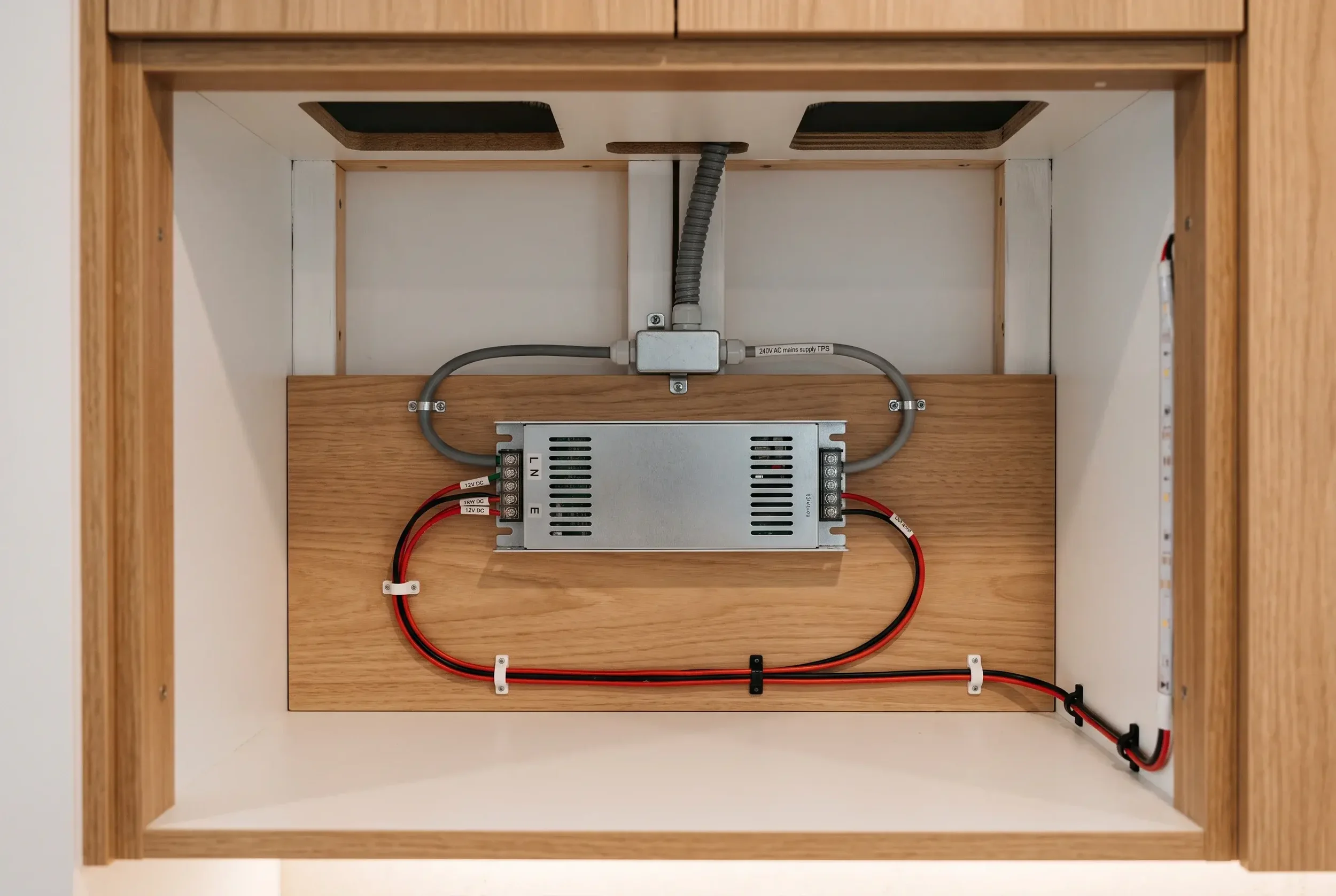
Most architectural LED strip runs at 12V or 24V, which sounds harmless. But the driver that powers it is connected to 240V mains, and most problems come from the driver and the installation, not the strip itself.
- Heat. Drivers and strip produce heat. Sealed inside a cabinet or ceiling without ventilation, they run hot, fail early and, at worst, become a fire risk.
- Undersized drivers. A driver running at or near its limit overheats and flickers. Good practice leaves headroom.
- Voltage drop. On long runs, cheap 12V strip gets dimmer and changes colour towards the far end.
- Poor connections. Twisted or taped joins in ceilings and cabinets are a common cause of failures.
- Cheap strip. Low-grade strip often uses thin copper and weak adhesive, and in Queensland heat and humidity it can peel off within months.
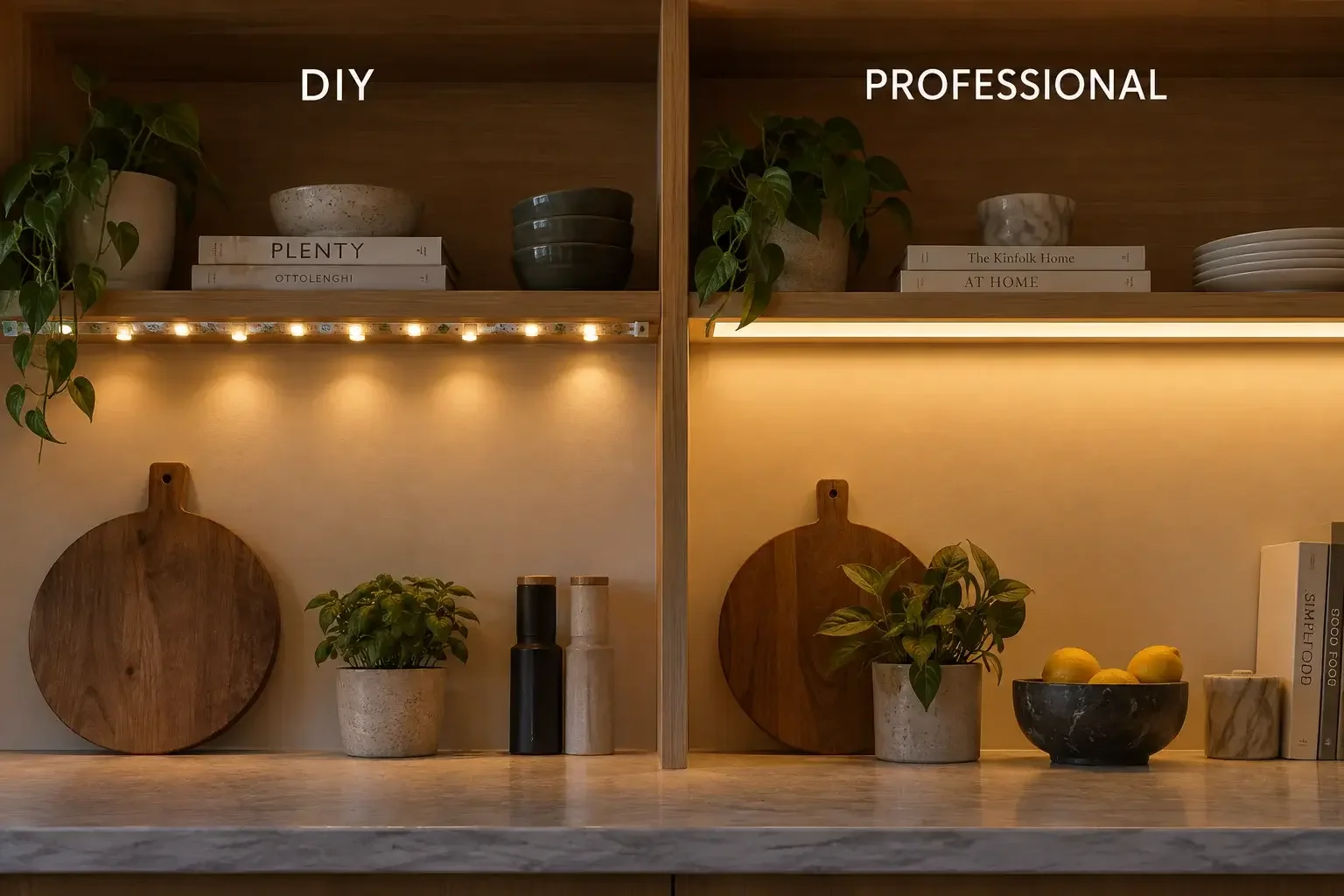
Why DIY strip usually looks DIY
Even when it's legal, plug-in strip rarely gives the built-in look people see on Instagram. The usual giveaways are a row of visible dots reflected in benchtops, strip sagging where the adhesive has let go, cables and adaptors on show, harsh or bluish light, and no way to dim it.
Professional strip lighting looks different because of what surrounds the strip: an aluminium profile recessed into the joinery or plaster, an opal diffuser, a correctly placed driver, and dimming that works smoothly.
Planning a build or renovation?
Luxe designs and installs architectural lighting across the Sunshine Coast and Brisbane. Book a lighting consultation.
What a professional install includes
A proper LED strip installation should include:
- Design. Where the light should fall, which colour temperature, and how bright.
- Quality strip. High-density, high colour rendering (CRI 90+), usually 24V.
- Aluminium profiles and diffusers. For an even line of light, heat dissipation and protection.
- Correctly sized, accessible drivers. With ventilation and room for maintenance.
- Compatible dimming. Dimmers and drivers chosen to work together without flicker.
- The right IP rating. For bathrooms, outdoor areas and anywhere near water.
- Compliance. A certificate of testing and safety for the electrical work.
That's how we approach every LED strip lighting job, including waterproof LED strip lighting for outdoor and wet areas. If you're planning a kitchen, our list of kitchen lighting ideas shows where strip makes the biggest difference.
Questions to ask any installer
Before you accept a quote for LED strip lighting, ask:
- What's your electrical contractor licence number?
- What brand of strip and driver are you using, and what's the CRI?
- Is it 12V or 24V, and why?
- Where will the drivers go, and can they be reached later?
- Will the strip sit in a profile with a diffuser?
- How will it be switched or dimmed?
- What warranty do you give on parts and workmanship?
- Will I get a certificate for the electrical work?
A good installer will answer all of these without hesitation. You can also read what our clients say about how we work.
Frequently asked questions
Can I install LED strip lights myself in Queensland?
You can install plug-in, low-voltage LED strip kits that run from a power point. Connecting a driver to 240V wiring, adding switches or dimmers, or running new circuits is electrical work, and in Queensland it must be done by a licensed electrician.
Are LED strip lights safe?
Quality strip installed in an aluminium profile with a correctly sized driver is very safe. Problems come from cheap strip, undersized or enclosed drivers that overheat, and strip stuck straight onto timber or inside cabinets without ventilation.
Is it illegal to do your own electrical work in Queensland?
Yes. Unlicensed electrical work can bring fines of up to $40,000, and much higher penalties if it puts someone at risk of death or serious injury. Your insurer may also refuse a claim for damage caused by illegal electrical work.
What's the difference between 12V, 24V and 240V LED strip?
Most architectural strip runs at 12V or 24V from a driver that converts 240V mains power. 24V handles longer runs with less voltage drop. 240V strip runs directly off mains and is mainly used outdoors on long runs; it must be installed by an electrician.
How long do LED strip lights last?
Good-quality strip is typically rated for tens of thousands of hours, which is many years of normal use. Lifespan drops fast if the strip runs hot, so an aluminium profile and a well-ventilated driver matter as much as the strip itself.
Get your free lighting quote.
Call 0411 212 528 or request your consultation. Licensed electrical contractor #90549.
